 The Fairway Wire
Editorial
Your Putt Is Rolling Over a Mattress You Cannot See
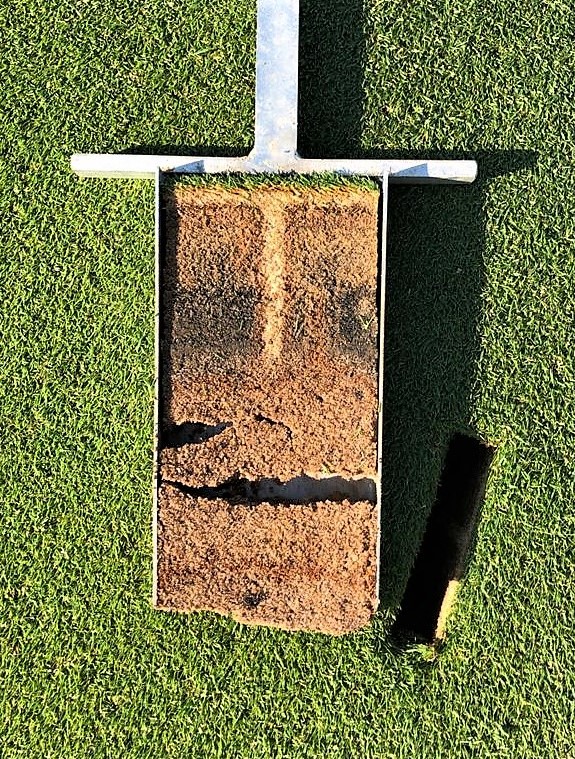
Under every green there is a spongy layer of dead stems and roots called thatch, and when it gets too thick your ball bounces, your green holds water like a sponge, and nothing I spray ever reaches the roots. A greens keeper from Ponte Vedra explains the layer nobody sees, why a little of it saves a green, and why too much of it quietly ruins one.
Pull a plug out of one of my greens sometime and look at it from the side, like a slice of cake. Green on top, sure. But right under the grass there is a brown, springy band that looks like the stuffing in an old couch cushion. That band is thatch, and I think about it more than I think about almost anything else on this golf course. Your putt rolls over it on every single green. You just never see it, because my whole job is keeping it where it belongs: underground, thin, and quiet.
Thatch is not dirt, and it is not dead grass somebody forgot to rake up. It is a layer of stems, roots, and runners that died slower than the ground could digest them. Bermuda is a running grass. It throws out stolons across the top and rhizomes underneath, and it grows so fast here in a Florida summer that the plant makes new tissue faster than the microbes in the soil can break the old tissue down. The leftovers pile up between the green canopy and the soil, and that pile is the mattress. A quarter inch of it is a cushion. An inch of it is a problem with a flagstick in it.
Here is what too much thatch does, and I have watched every bit of it happen. Water sits in it. I can run my sprinklers at night, come out at dawn, and find the top of the green wet and the roots underneath bone dry, because the thatch drank the whole irrigation and kept it. Fertilizer does the same thing — it lands in the sponge and feeds the layer instead of the plant. Disease loves it, because a wet sponge that never fully dries is a fine apartment for fungus. And your ball knows it before I say a word. A putt across a puffy green does not roll, it trundles. It hops a little. An approach shot lands and checks like it hit a waterbed instead of biting and settling. Golfers call that green soft like it is a compliment. From where I stand, soft is the mattress talking.
A little thatch, now, earns its keep. It cushions the crown of the plant, the growing point I cannot replace if a mower scalps it or a cart tire grinds over it. It shades the soil in August when our sand gets hot enough to cook roots. It gives the green a touch of give so a ball landing from a hundred and fifty yards does not bounce like it hit the cart path. I do not want zero thatch. Zero thatch is a green living with no padding at all, one bad week from showing you its bones. The whole craft is the middle: enough mattress to protect the plant, never enough to swallow the water, the food, and the roll of your ball.
So how do I keep it in the middle? Mostly by bothering it, regularly, in ways golfers grumble about. I slice it with vertical blades that cut down through the layer and pull the dead material up where the sun and the microbes can finish it. I dust the greens with light coats of sand all season long, and that sand is not there to annoy your putter, whatever the Saturday group says. Sand works down into the thatch and dilutes it, mixes mineral into the organic pile so it breaks down faster and drains like it should. When I pull cores in the summer, half the reason is right there in that brown band: get some of it out, get sand in, let air reach a layer that has been holding its breath. And I watch my nitrogen. Feed a Bermuda green like it is at an all-you-can-eat buffet and it will happily grow you a thicker mattress than any machine I own can thin.
The honest test is not fancy. I take my plug cutter, pull a core, and measure the brown band with my thumb. Then I squeeze it. A good layer springs back a little and smells like earth. A bad one squishes like a kitchen sponge, holds water when I wring it, and smells sour, like a pond that gave up. I do that on every green, a few spots each, because thatch does not build evenly. It builds worst where the water sits, where the shade lingers, where the grass grows happiest — which is a mean little joke, because the prettiest, thickest turf on the course is usually the one hiding the fattest mattress underneath it.
Next time your putt comes up two feet short on a green that looks perfect, do not blame your hands right away. There may be an inch of old stems and stubborn roots under that ball, drinking the speed out of it before it ever gets started. Somebody out here is measuring that layer with his thumb at six in the morning, slicing it, sanding it, and arguing with it all summer long, so that the one thing you notice about my greens is that there is nothing to notice at all.