 The Fairway Wire
Editorial
Why I Just Put Sand All Over Our Best Greens
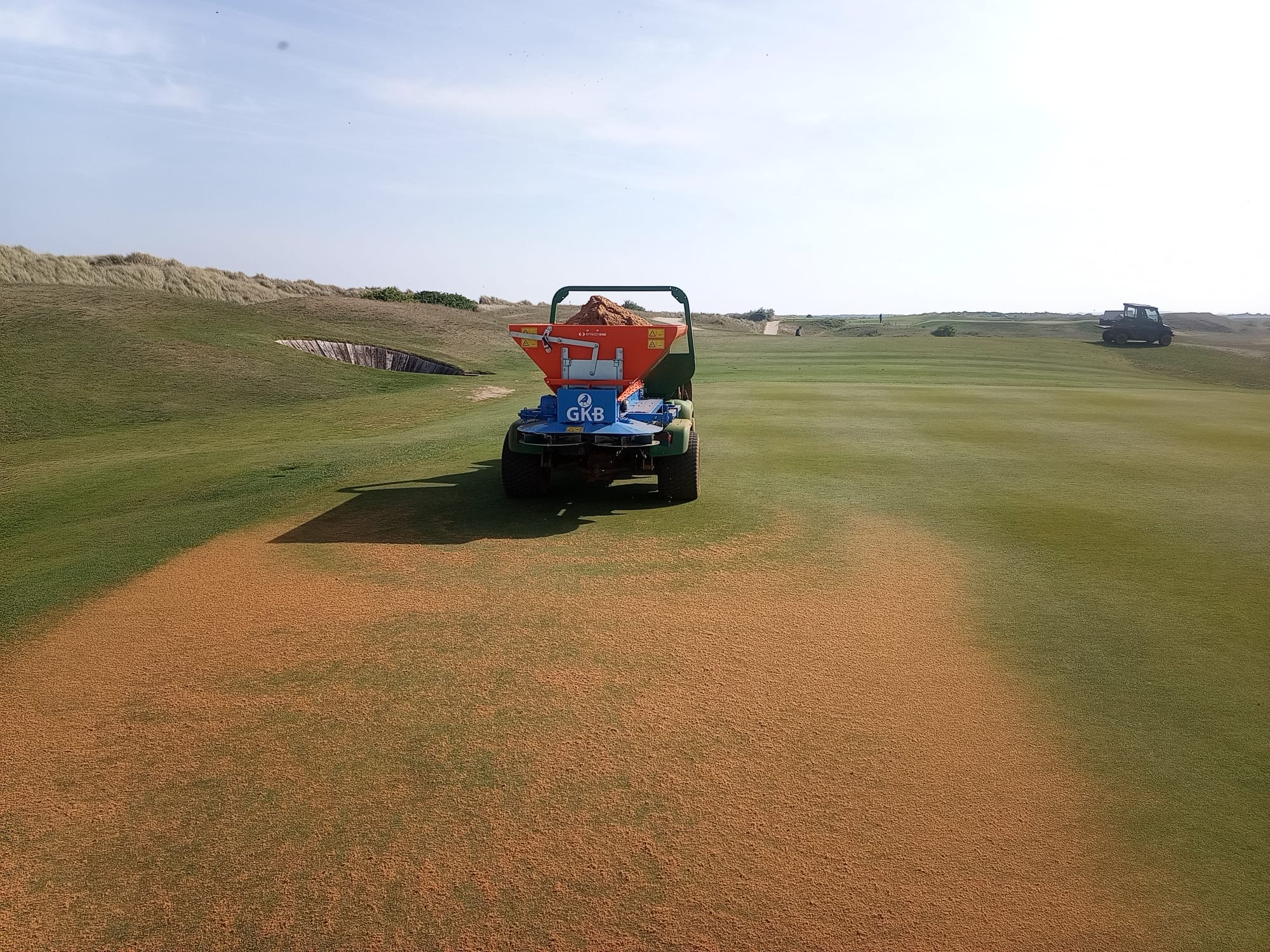
Topdressing looks like a crew ruining a perfect green on purpose — because it is on purpose. A working greens keeper explains how light layers of the right sand keep greens firm, smooth, and honest, and why the gritty day is the price of the true roll a week later.
It never fails. We spend weeks getting the greens pure — mowed clean, rolling true, that deep green color that makes you want to take a picture on the first tee — and then I drive out in broad daylight and cover them in sand. By the second green, somebody is waiting by the cart path, polite about it, mostly. He just wants to know if we lost our minds on purpose.
It is on purpose. It is called topdressing, and if I could only keep one habit for the long-term health of a green, there is a real argument it would be this one. I know how that sounds, staring at a surface that looks like a beach towel got shaken out over it. Give me two minutes and I can usually talk a man down — though for a day or so, he has a point. Putts do hop. Shoes do come away gritty.
Here is what is happening under all that mess. A green is grass growing in sand to begin with — that is how a modern green is built — and all season the plant does what living things do. It grows leaves, sheds them, grows roots, sheds those too. That dead material builds up under the surface as thatch and organic matter. A little of it is cushion. Too much is a sponge. A spongy green holds water at the top, stays soft, gets bumpy late in the day, and invites every bad thing Florida humidity is already shopping for. Sand is how we dilute it — light layer by light layer, worked down into the canopy so the surface stays firm and drains as it was built to drain.
The second job is honesty. A ball rolls on the surface the blades create, and that surface is always trying to go wavy — a heel print here, an old ball mark settling there, growth a fraction faster on one side than the other. A light dusting of sand, brushed in properly, fills the tiny low spots nobody can see and everybody can feel in a breaking putt. We are not changing the green, just evening it back out. Most of the smoothest putts you will roll all year happen about a week after a topdressing you probably cussed at when you saw it.
How we do it matters more than that we do it. The modern way is little and often — a light application every couple of weeks in the growing season, not a burial twice a year. We put it down dry, on dry grass, so it falls where it belongs instead of sticking to wet leaves. Then we brush it, drag it, brush it again, and water it in, until what is left on top is mostly a tan haze. Done right, you can putt through it the same day and forget it by the weekend. Done lazy — dumped heavy, left in clumps on a wet green — it smothers turf and dulls mower blades, a whole other sin I have strong feelings about.
And the sand itself is not negotiable. It is not play sand, not bunker sand, and sure not whatever was cheapest by the truckload. The particle size has to match the mix the green was built with. Too fine and it seals the surface shut. Too coarse and it sits up top, wrecks the reels, and turns every putt into a gravel road. When it matches, it disappears into the profile and becomes part of the green. When it does not, you have built a layer, and layers in a green are like secrets in a small town — they always come up later, usually at the worst time.
So yes, there is a trade. You give us one gritty day, maybe two, and a few putts that do not roll quite like the brochure. In exchange, your greens stay firm in August instead of squishing under your spikes, drain after a storm instead of puddling, and roll true late in the day when a spongy green would be foot-printed into a waffle. I would make that trade every time, and I do — about every two weeks, all season.
The next time you see that light tan dusting between the blades, do not feel sorry for it. It is not ruined and not under repair. It is being kept. That sand is why the surface under your ball feels like a table instead of a pillow, and it will be gone from sight long before the good it does is gone. We do not put sand on our best greens despite how good they are. We put it there because of it.