 The Fairway Wire
Editorial
Those Red Stakes Did Not Walk Out There by Themselves, and Please Stop Moving Them
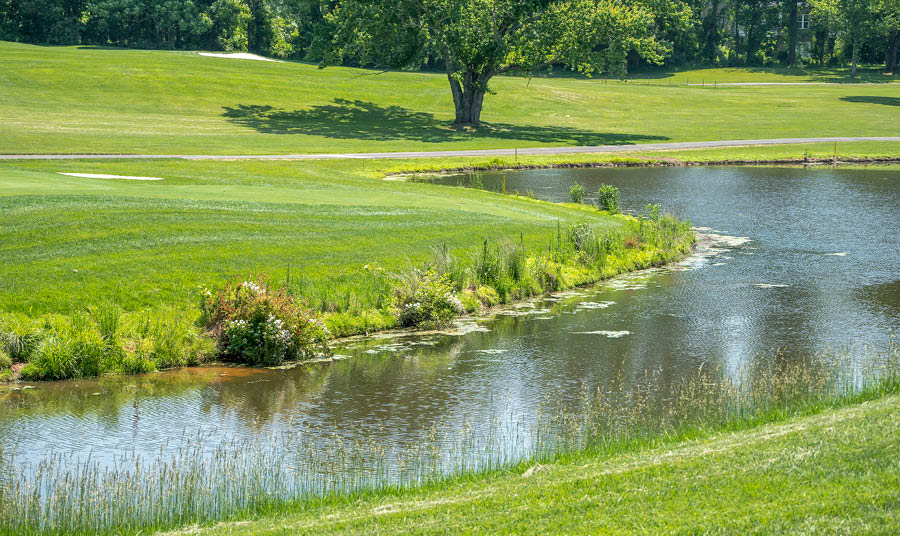
Red stakes draw the honest line around every pond on my course, and a crew hand placed each one in the mud. When a stake gets pulled for a swing and stuck back a pace off, the next group plays a different pond — so put it back in its own hole.
Every pond and marsh on this course wears a line of red stakes along its edge, and I can tell you exactly who put them there, because my boots still remember the mud. Those stakes did not come with the property. A man on this crew — plenty of mornings, that man was me — walked that bank with a bundle of stakes under one arm, a mallet in the other hand, and wet socks by the third hole.
A stake looks like the simplest thing on a golf course. It is a painted stick. But that stick is doing real work. Strung together, stake to stake, they draw the edge of the penalty area — the line that decides whether your ball is in the pond's business or still in yours. Where that line sits decides where a drop gets measured from, and a drop measured a few feet wrong can turn a drowned tee shot into a friendly little pitch. The line has to be honest, and in the same place for the first group at daylight and the last group limping in at dusk. That sameness is my department.
Setting them right is slower work than it looks. You walk the water's edge and judge where fairway rough stops and pond bank starts — where the mowers cannot safely go, where the grass gives up and the reeds take over. Too far out and we have stolen dry ground from the golfer. Too far in and we have given away bank that swallows balls and ankles alike. You drive the stake plumb, not leaning like it had a long night, deep enough to stay put, shallow enough to pull when the bank itself moves — and in Florida, after a wet month, banks do move.
Then the course spends the rest of the year trying to undo them. The sun bleaches red paint down to a tired pink by August, and a pink stake reads like a rumor instead of a ruling, so back out we go with fresh ones. A mower catches one left a hair proud and snaps it at the ground. Storm water floats a loose one clear across the pond, and I find it days later stuck in the reeds. There is no new line over there. There is the line, and there is my job putting it back.
The undoing I understand least comes with two hands and a tee time. A ball settles near a stake, the stake crowds a backswing, and out it comes — which the rules of this game actually allow, since those stakes are there to be moved when they block a swing. What the game counts on is the second half of that bargain: the stake goes back where it came from. Too often it goes back a pace closer to the water, or a pace farther out, or dropped flat in the grass. A pace does not sound like much. A pace is the whole argument. The foursome behind you is now playing a different pond than the one you played, and neither of you did anything on purpose. That is why the crew sweats the small stuff — so luck stays in the bounce and out of the boundary.
The colors carry their own meanings. Red marks the penalty areas here — ponds, marsh, the wet low ground this flat Florida land is always trying to return to. White is sterner stuff: out of bounds, property lines, no drop and no discussion. Yellow shows up where water crosses a hole head-on. A golfer sees a splash of color in the rough. I see a sentence somebody has to be able to read at forty yards, in flat light, with a round going sideways. Faded, leaning, or missing is a sentence with words left out.
So here is my whole request, and it is a small one. If you pull a stake to make your swing, good — take your swing. Then look down before you walk away. There is a hole in the ground where that stake lived, dark and plain as a footprint. Put the stake back in its own hole, tap it snug with your shoe, and the line you leave behind is the line you found. If one is down or snapped, leave it be and tell the shop. By tomorrow's first tee time it will be standing straight and red again.
Golfers talk about the honor in this game, mostly around scorecards. Out here the honor is smaller and more physical than that. It is a painted stick returned to its hole by a man who could have walked off and let the next group sort it out. Nobody would ever know. That is rather the point of it. The stakes hold the line for everybody. All I am asking is that everybody help hold the stakes.