 The Fairway Wire
Editorial
The Yellow Patch by the Cart Path Is Not Thirsty. Something Is Drinking It Dry.
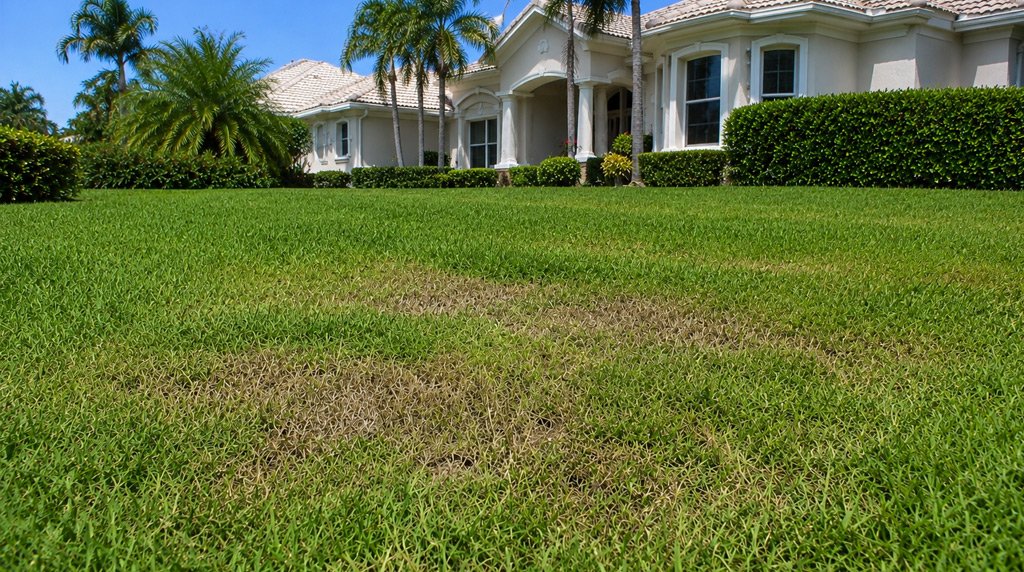
That yellow patch by the cart path looks thirsty, but no amount of water will save it. A Ponte Vedra greens keeper gets on his knees with a coffee can to show you the tiny thief drinking the grass dry from the inside.
Every summer I get the same report, usually from a regular who means well. There is a yellow patch out by the cart path, he says, and it looks thirsty. He is half right. It looks thirsty. But I can water that spot until the path floats and it will keep dying, because the problem is not a lack of water going in. The problem is a crowd of little thieves drinking the plant dry from the inside, one blade at a time.
The thief is the chinch bug, and around Ponte Vedra he is as much a part of summer as the afternoon storm. He is tiny — full grown, he would not cover your thumbnail, black body, white wings folded across his back. You will almost never see him from a cart. He lives down at the base of the grass, right where the blade meets the stem, in the shade of the canopy he is busy ruining. The damage shows up at the top of the plant, and the criminal never leaves the basement.
Here is what he does. He pokes his mouthparts into the blade like a straw and sucks the juice out, and while he is at it he leaves something behind that clogs the plant's plumbing. So the grass starves and dries at the same time, in the middle of a course that got watered last night. First it yellows in a rough circle. Then it goes the color of a paper bag. Then it thins out and quits. And it almost always starts in the hot, sunny edges. Along the cart path. Beside the sidewalk by the clubhouse. Wherever pavement has been baking all day and throwing heat back at the turf. Chinch bugs love a sunburn, as long as it is somebody else's.
That is what makes them so easy to misread, and I misread them myself when I was greener at this. A patch that looks like drought, in the hottest spot on the hole — every instinct says water. I have stood there with a hose feeling virtuous while the bugs treated my watering like room service. Water does not fix a clogged plant. The tell is simple: a thirsty patch perks up after a deep drink and a cool night. A chinch patch keeps spreading at the edges, because the bugs work outward from the dead center toward the healthy grass, like a fire moving in slow motion.
So we do not diagnose from the cart. We get down on our knees, which is where most honest answers on a golf course live anyway. You part the grass at the edge of the patch — not the dead middle, the living edge, where the work is still happening — and you look close and wait. They hate being exposed, and after a few seconds they start moving. There is an old field test I still trust: cut both ends out of a coffee can, press it into the turf at that edge, fill it with water, and watch what floats up. Bugs, mostly, and a little of your pride, because sometimes you have been watering a bug colony for two weeks.
Once you know it is them, the fight is unglamorous. You treat the patch and a good margin around it, because the edge you can see is behind the edge they have reached. A good crew spot-treats, marks the spot, and comes back to look again, because one pass rarely ends a Florida summer argument with an insect. The dead grass does not resurrect. It gets raked out, and the bare ground gets fresh soil and a few plugs from a healthy corner. Recovery is measured in weeks, and the regular who reported it will ask me twice before it fills in. That is fine. At least the second time, I have better news.
That yellow patch teaches everybody who works on a course the same thing: not every sick plant is thirsty, and the loudest symptom is often sitting a long way from the cause. A golfer sees color. A greens keeper has to see a system — sun, pavement, water, bugs, and a plant caught in the middle of all of them, trying to grow.
So if you roll past a man on his knees this summer, parting the grass at the edge of a yellow patch and staring at it like it owes him money, wave and keep your putt dry. He is not resting. He is reading the fine print. And somewhere under his hands, a few thousand tiny straws just got found out.