 The Fairway Wire
Editorial
The White Ibis Flock Is Doing Pest Control on My Fairway, One Poke at a Time
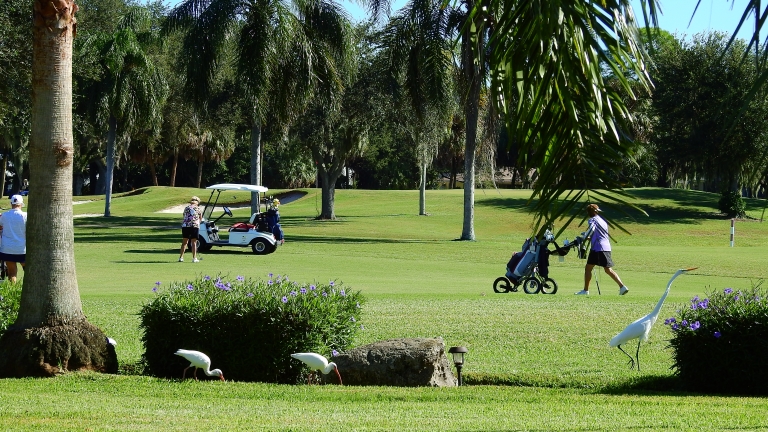
A flock of white ibis works Cliff's fairways every morning, probing the soil with bills that can feel a grub move underground. He explains how the birds do free pest control, why a bunched-up flock is his earliest warning of trouble below the surface, and why golfers should let them finish their shift.
They show up like they have a tee time. Twenty, sometimes thirty white ibis, all in a loose line across the fairway, heads down, taking two steps, poking the ground, taking two more steps. No hurry. No noise except the odd grunt. If you did not know better, you would think I hired them and forgot to tell anybody.
I did not hire them. They hired themselves, and frankly, they are better at one part of my job than I am.
That long, curved orange bill is not decoration. It is a probe. An ibis walks my fairway feeling underground with it, the way you or I would run a hand along a dark shelf looking for keys. The tip of that bill can sense movement in wet soil — a grub shifting, a mole cricket backing up, a worm minding its own business an inch down. The bird does not even have to see its lunch. It feels it, snaps, and comes up chewing. All morning long. Fairway after fairway.
Now, understand what that means to a greens keeper in northeast Florida. The things living just under my turf are not all friends. White grubs chew roots from below until a patch of fairway lifts up like a loose toupee. Mole crickets tunnel and feed and turn a smooth lie into a miniature plowed field. I can treat for them — and sometimes I have to — but every treatment costs money, takes timing, and deserves respect, because you do not put anything on grass lightly. A flock of ibis does the same hunt for free, with no tank to mix, no label to read, and no re-entry interval. They are pest control that flies in, clocks in, and never asks where the coffee is.
They are also honest about where the trouble is. If I see the flock bunched up tight on one corner of a fairway, poking twice as fast as usual, I make a note. That corner is holding something they want — usually because the soil stays wet there, and wet soil is where the underground buffet sets up. More than once the birds have pointed me at a grub problem a week before the grass showed a single brown sign of it. The grass is always the last to know. The ibis are the first.
Golfers, for the most part, love them right up until one stands on their line. I have watched a man wait a full minute, putter in hand, while a single ibis strolled across the green in front of his ball like a mayor crossing the street. He laughed. They usually do. There is something about a bird that white, on grass that green, under a Florida sky, that resets a bad round better than a beverage cart. And if one of them pulls a grub out of the fringe while it waits, well, that bird just earned its keep in front of witnesses.
They are not perfect employees. They leave little probe holes in soft ground after a rain, tiny divots of their own, though nothing a morning mow and a week's growth will not erase. The young ones — brown and patchy, like teenagers who have not grown into the uniform yet — are bolder and dumber and will stand in a cart path arguing with a cart until the last possible second. And the whole flock can lift off at once for no reason I will ever be told, wheel around the pond, and land on the exact fairway they just left, as if the meeting decided nothing.
November is prime ibis season on my course. The ponds are lower, the fairways stay damp longer in the morning, and everything they hunt sits closer to the surface. Some mornings the flock works the sunny side of number four like a crew with a quota. I will slow the mower down at the edge of the fairway, kill the blades, and just watch for a minute. A man who spends his life trying to keep grass alive learns to appreciate anything that helps him do it without being asked.
So if you come out to play and find thirty white birds spread across your fairway, heads bobbing like a row of sewing machines, do not shoo them off and do not rush them. They were here at daylight, same as me. They are eating the things that eat my course, one poke at a time, and around here, that makes them crew.