 The Fairway Wire
Editorial
The Spots on My Green Are the Size of Silver Dollars, and They Grew There Overnight
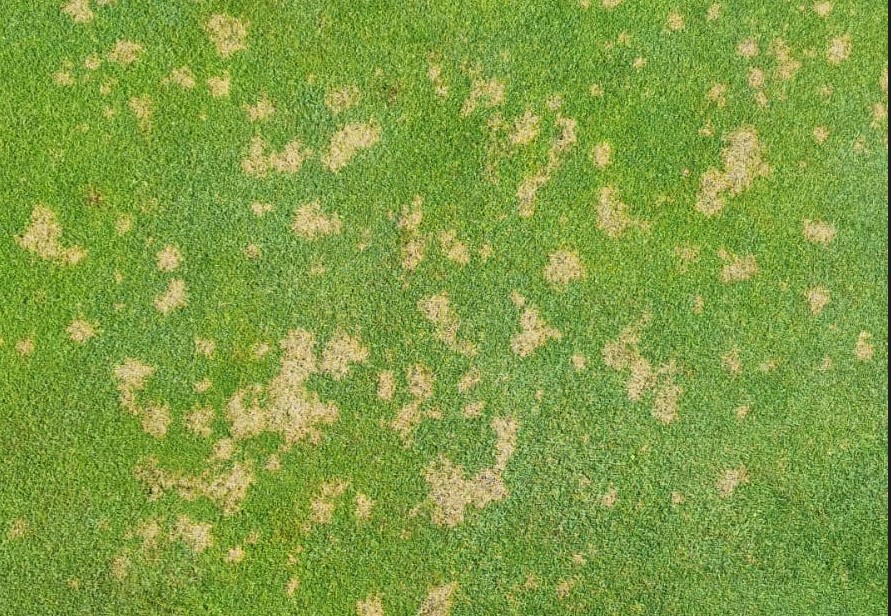
A green that was clean at sundown can wake up freckled with pale circles the size of silver dollars. That is dollar spot, a fungus that eats wet, hungry grass overnight — and the fix starts with a knee on the ground, a pinched leaf blade, and feeding the turf before ever reaching for the sprayer.
The first man to find them is whoever walks that green at dawn, and yesterday morning it was me. At sundown that green was clean enough to eat off of. At first light it looked like somebody had scattered pocket change across it in the dark — a few dozen pale, straw-colored circles, every one of them about the size of an old silver dollar, sitting there in the dew like the green had broken out in freckles. Nobody spilled anything. Nobody tore it up. That is dollar spot, a fungus, and it did most of that work in a single warm, wet night while the rest of us were home asleep.
Dollar spot lives in the thatch and the soil all the time, waiting on its weather. What it wants is a warm night, soupy humid air, and grass blades that stay wet ten or twelve hours straight. Give it that, and it wakes up hungry. Down here in Ponte Vedra it gets a second season in late fall, because my overseeded rye comes up tender right when the dew turns heavy and the nights still sit in the sixties. The leaves stay wet till mid-morning, and the fungus throws itself a banquet.
I can tell dollar spot from its cousins because I get down on one knee and read the blades at the edge of a spot, right where the tan meets the green. A sick blade wears a pinch in the middle, tan in the center with reddish-brown edges, like an hourglass somebody squeezed. That hourglass never lies. And early enough, before the sun burns it off, I find fine white threads strung between the blades, cobwebby stuff that vanishes by nine. A dry spot never does that, and neither does a dull mower. Ten seconds of knee work saves me from treating the wrong problem, the most expensive mistake in my business.
Golfers read those circles wrong, and I cannot blame them. From the fringe, a spotted green just looks thirsty or scalped. What they are actually putting across is a few hundred dead and dying blades per spot, sitting a hair lower than the healthy grass, so a ball crossing one wobbles like it caught a seam in the floor. One spot is nothing. Fifty spots start holding hands and merge into blotches, and then the green is not just ugly, it is dishonest — it will not roll true, and a green that will not roll true is the one thing I am paid to never hand you.
Here is the part nobody expects: a bad case of dollar spot is usually a hungry green talking. This fungus loves grass that is short on nitrogen, turf running lean and slow. A well-fed green grows fast enough to fight back, pushing new leaves up through the damage. A starved one just sits there and takes it. So part of my fix is a light feeding, spooning the green back to health so it can outgrow the freckles. Grass can grow out of dollar spot the way a man grows out of a bad haircut — slowly, and only if you feed it while it heals.
The rest of the fight is about water standing where it should not. The fungus needs wet leaves the way a fire needs air, so my cheapest medicine is getting the dew off early. We mow at dawn, we knock the dew down, and every hour of dry leaf is an hour the fungus goes without a meal. It is also why I water deep in the early morning and never send a green to bed wet at night — evening irrigation on a humid Florida night is room service for a fungus.
When it gets ahead of us, yes, we spray, and I am not ashamed of it. But we rotate what goes in the tank, because this fungus learns. Lean on one product long enough and it stops working. The sprayer is my last line, not my first. Fertility, dew, and water timing do the daily work, and they do it cheaper.
By next week those circles will be grown out and mowed away, and not one golfer in ten will know they were ever there. That is fine. My job has always been reading little signs at dawn that nobody else sees — a pinched blade, a white thread, a circle the size of a coin. A silver dollar will not buy you a cup of coffee anymore. On my green, it still tells me the grass is hungry, the nights are wet, and it is time to get to work.