 The Fairway Wire
Editorial
The Quiet Half Hour Between Waves Is When This Course Gets Fixed
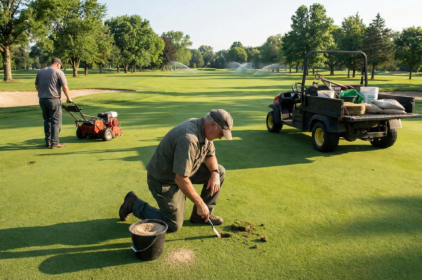
Twice a day my Ponte Vedra course goes still: the morning groups are finishing, the afternoon groups have not teed off, and for about thirty minutes nobody needs the grass but us. That little gap is when the crew does the repairs that keep the place standing.
Every golf course has a heartbeat, and if you work on one long enough you can feel it without looking at a clock. Mine beats in waves. The first groups go off at daylight and push around the course like weather moving across a map. Behind them comes a lull, then the late-morning crowd, then lunch, then the afternoon wave. And twice a day, if the tee sheet has any mercy in it at all, there is a quiet half hour when the course belongs to nobody. That is when we fix it.
I do not mean the big work. Nobody is rebuilding a bunker in thirty minutes. I mean the hundred small rescues that never make it onto a work order because they cannot wait for one. A sprinkler head sitting cockeyed after a cart kissed it. A patch of fairway going yellow at the edges. A tee marker knocked flat. A bunker face slumped in after the morning rain. All morning we ride past these things and make a list in our heads, because stopping in front of a group with a shovel is bad manners and worse business. The list waits. The gap is when the list gets worked.
The starter knows the gap better than anybody. He will wave us through with two fingers, the way a traffic cop waves a truck through a light, and that little wave means go, and go now, because the next foursome is paying for range balls and time is already spending itself. We roll out like a pit crew that lost its uniforms. One man to the bunker with a rake and a shovel. One to the sprinkler with a wrench and a level head. Me, usually, on my knees somewhere with a bucket of sand mix, filling the worst of the morning's divots on the holes that take the most iron shots.
There is a rule in the gap and everybody on the crew knows it cold: never start a job you cannot walk away from. A repair half done when golfers arrive is worse than a repair not started, because now it is a hazard with a witness. So we pick work that finishes clean. Swap the head, do not rebuild the line. Sand the patch, do not dig up the whole corner. Rake the bunker face smooth, do not re-sculpt it. The big surgery belongs to dawn, when we own the course outright and the only audience is herons. The gap is for field medicine, and field medicine has one job: stabilize it, make it honest, move on.
People ask me sometimes why the course looks better at two in the afternoon than it did at nine in the morning, and they never believe the answer. Nothing was added. Nobody mowed anything twice. The course just got its half hour. The morning wave spends a golf course the way a family spends a kitchen — everything used, nothing put back. The gap is when the kitchen gets wiped down. Cups are not moved, pins are not changed, but the day's damage stops compounding, and a course where the damage stops compounding is a course that still looks cared for at sundown.
The gap also tells the truth about a crew. Anybody can look sharp at six in the morning with a fresh course. The gap asks a different question: what did you notice while you were busy doing something else? The man who rides past a leaning flagstick at nine and fixes it at noon was working the whole time. Attention is the real tool. The shovels are just what attention picks up.
Some days there is no gap. An outing fills the sheet wall to wall, a rain delay stacks the groups like planes over an airport, and the list in my head just grows longer and heavier until dark. Those are the days a course pays interest. A cockeyed sprinkler waters a path for a week. A yellow patch becomes a brown one. Small neglect does not stay small on living ground; it spreads at the speed of grass, which in Florida is faster than you think.
So when the starter gives us that two-finger wave, I take it like a gift, because that is what it is. Thirty quiet minutes, a short list, and a crew that already knows where everything hurts. Tomorrow morning the first group will walk out onto a course that looks like nobody ever damaged it at all. That is not an accident. That is the gap, doing its work where nobody sees it.