 The Fairway Wire
Editorial
The Mud Hens Are Back, and They Are Eating My New Grass One Beak at a Time
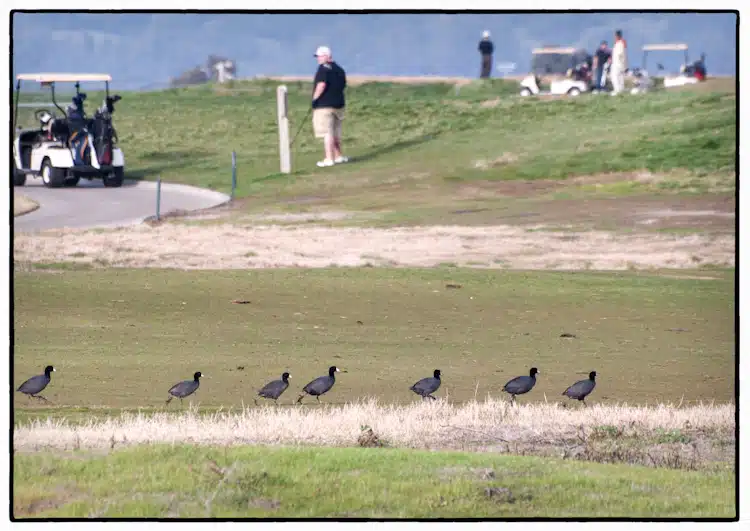
Every fall a flock of dark little water birds moves into our ponds and walks straight onto the fresh ryegrass like they ordered it. I cannot run them off for good, I cannot keep them off a green they have claimed, and every morning I rake up what their beaks pulled loose and seed it again.
The first sign is not the birds themselves. It is the little pulled-up tufts floating in the pond at daylight, green confetti on dark water. I stood there with my coffee going cold and I knew before I ever looked up. The mud hens are back for the winter, and they have already found the new grass.
A mud hen is an American coot. It is not a duck, though most golfers call it one. It is a dark gray bird about the size of a small chicken, with a white bill like a dab of paint, red eyes, and the strangest feet in Florida — long greenish toes with flaps on them, built half for swimming and half for walking on soft ground. That second half is my problem. A duck stays in the water. A coot commutes. It swims at dawn, then marches up the bank in a loose black parade and grazes my golf course all day like it pays dues.
And what it wants, this time of year, is the worst possible thing it could want. We put down ryegrass seed a few weeks back so the course stays green through the winter, and young rye is tender. For its first weeks it sits shallow, sweet and barely holding on. To a coot, a fresh overseeded fairway is not turf. It is a salad bar with the sneeze guard left off. They walk in a line, heads bobbing — a coot never does anything without bobbing its whole head, like it is agreeing with itself — and they nip and pull, nip and pull. Half of what they grab comes up root and all. One bird is nothing. Sixty birds, working a tee box all morning, can thin a stand of new grass faster than I put it down.
The greens get their own insult. Coots that wander onto a putting surface leave droppings that a mower will find before I do, and a mower turns a small mess into a long green smear right across the line of the first putt of the day. Their big lobed feet press half-moon prints into a soft, wet green that I then get to explain. Nobody walks in and says, "Cliff, beautiful sunrise." They say, "Cliff, what happened on number seven?" What happened on number seven weighs two pounds, has a white bill, and has not one minute of shame in its body.
Here is the part golfers never believe: there is very little I am allowed to do about it, and even less that works. Coots are protected migratory birds, so this is not a problem you solve the direct way, and honestly I would not want to. They were flying this route long before there was a fairway under it. So we haze. I drive the cart out, wave my arms like a man flagging down a rescue plane, and sixty birds lift ten feet, splash down twenty yards over, and look at me with a patience I can only describe as professional. Fake coyotes work for about a day and a half, until a coot walks up and stands next to one to eat, which tells you who won that arms race. Noise, a hose, a crew dog trotting the bank — all of it buys an hour. The birds have all winter. They can wait me out, and we both know it.
So the real work is quieter. In the mornings I walk the worst-hit tees and collars with a bucket of seed and a rake, scratching in a little more rye where the flock has thinned it, We hold a touch more water on the young stands so the roots run down faster, because the game is getting that grass anchored fast. Once the rye is established and tough, the coots still graze it — they never stop — but they nip the tops like lawnmowers instead of pulling up the whole plant. That is the truce this course makes every year. They get to eat. I get to keep most of it. We argue about the percentage until spring.
And I will confess something: by December I kind of like having them here. They are the surest sign in Florida that the season has truly turned, more honest than any calendar. Watching a whole black flotilla part down the middle for my mower, unbothered, bobbing, completely at home, reminds me whose place this was first. My job is to grow grass in a world that keeps eating it, one beak at a time. This week the eating started again. So did I.