 The Fairway Wire
Editorial
The Most Important Valve on This Course Never Waters a Blade of Grass
By the street sits a brass contraption in a green cage that no golfer has ever thanked. Once a year a man with gauges comes to test it, and if it fails, nothing else on my fill line matters — because its one job is making sure course water only ever travels one way.
Every November a plain envelope from the city lands on the shop desk, and nobody fights me for it. It is a notice that our backflow preventer test is due, which means a certified tester will soon stand by the street with his gauges, and a piece of brass most golfers have driven past for years will get the most important exam on this property. That valve has never watered a single blade of grass. Its whole job is the opposite direction.
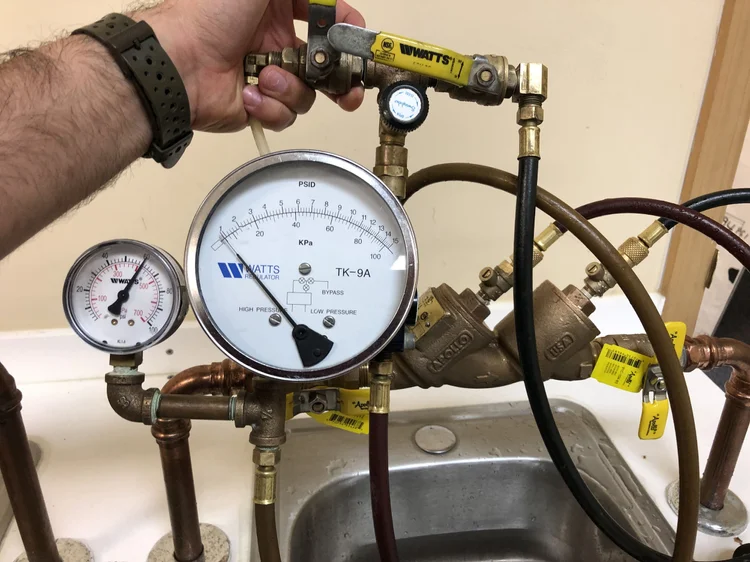
Down where our water line meets the street, inside a green cage that looks like it guards something electrical, sits a squat brass assembly with two shutoff handles, four little test cocks, and more springs and seals than a watch. Plumbers call it a reduced pressure zone assembly, a long name for a simple promise: water may travel from the city into this golf course, and it may never, under any circumstances, travel back.
Golfers never think about that direction, so let me walk it backward for you. Once city water crosses onto my course, it stops being drinking water in any honest sense. It sits in miles of pipe. It fills ponds. On the feed lines, it can carry fertilizer we metered in on purpose. At the mix pad it shares a world with spray tanks and rinse water. All of that is fine, as long as it stays mine. The trouble starts the day city pressure drops — a main break two streets over, a hydrant being flushed, a big draw uphill. Pressure keeps water honest. Lose it, and water can siphon backward the way soda climbs a straw, carrying my side of the line toward somebody's kitchen tap. The brass by the street exists so that story can never happen.
Inside it, two check valves stand guard in a row, each a one-way door held shut by pressure and a spring. Between them sits a relief valve watching the space in the middle. If the first door ever leaks and pressure builds where it should not, the relief valve does not argue. It dumps that water out the bottom onto the ground. That is why a puddle under the cage is not always bad news. Sometimes it is the device choosing a wet sidewalk over a contaminated water line, and I will take that trade every day of the week.
Test morning runs on the tester's clock, not mine. He hooks his gauge kit to those little cocks, shuts my fill line down, and bleeds the assembly in a set order, reading numbers I am not certified to argue with. He is checking that each check valve holds its margin and that the relief valve wakes up at the right difference in pressure, not a pound sooner or later. Pass, and he wires a fresh tag to the handle and the city gets its copy of the paperwork. Fail, and the day changes: the assembly comes apart on a tailgate, out come tired rubber disks and springs, in goes a repair kit, and we test again before that fill line runs. There is no close enough. A device that guards drinking water passes, or it gets fixed. It does not get a pep talk.
The same idea rides in miniature at the mix pad. No hose of mine ever rests down inside a tank while it fills. We fill across an air gap, hose held above the rim, because a hose end sitting in mixed spray is a straw waiting for a bad pressure day. The big assembly by the street is that habit grown up and made of brass: never give course water a path back into clean water, not even an accidental one, not even for a minute.
Nobody takes a picture of it. The cage is there because brass invites thieves and a stray mower bumper can bend what it cannot see, and I keep the weeds cut back so the tester can work in peace. Members roll past it on their way to the first tee thinking about a swing, and that is as it should be. The greens get the compliments. The bunkers get the complaints. That valve gets a tag once a year and silence the rest of the time.
I am fond of it anyway. Most of my job is making grass presentable for people judging it by Friday. That assembly guards people who will never know my name, on streets I do not mow, without applause. If it does its job for the next thirty years, nobody will thank it, because nothing will ever happen. Out here, nothing happening is the finest review a piece of equipment can earn.