 The Fairway Wire
Editorial
The Little Lizards on the Tee Markers Are Doing Push-Ups for a Reason
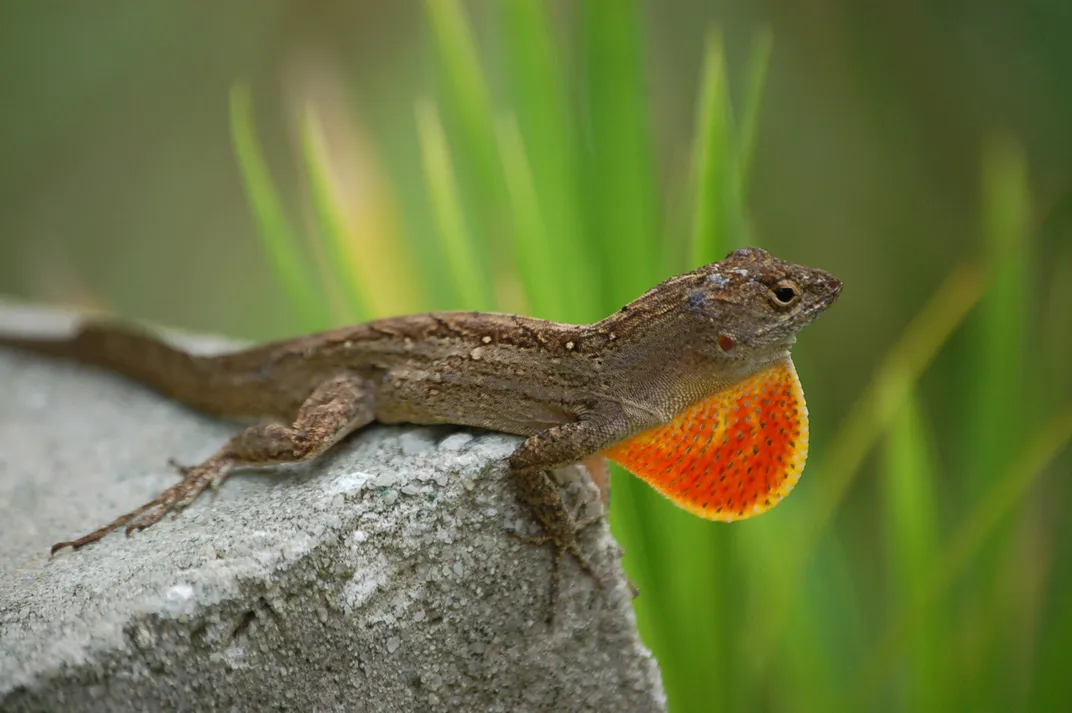
Every tee marker and signpost on my Ponte Vedra course has a little lizard posted on it by sunrise, doing push-ups and flashing a red throat fan at the world. Those anoles are not decoration — they are working the shrub beds and pond edges all day, eating flies and gnats, and telling every rival male that this corner of the course is taken.
If you stand on any tee box on my course in Ponte Vedra long enough to read the yardage sign, you have already been looked at by an employee you did not know we had. He is about six inches long, most of that tail, posted on the tee marker or flat against the signpost in the morning sun, doing slow push-ups like a man warming up for work he fully intends to do. The kids in your group always spot him first. I have watched that little lizard for years, and he is not showing off for your gallery. He is working a territory, advertising it, and eating better than half the field, all before your group clears the fairway.
The lizards are anoles, and we have two kinds sharing this ground. The green anole is the Florida native, bright green on a warm morning, able to fade to brown by afternoon depending on light, temperature, and stress. It is not a true chameleon, whatever your playing partner insists — it changes shade, not costume. The brown anole came up from Cuba and the Bahamas generations ago and liked Florida so well it never left. Browns run the ground and the low walls. Greens keep the higher perches in the bushes and palm trunks. Between them they have divided this course into more small countries than I could draw on a map, and every border gets patrolled daily.
Now, about those push-ups. A male anole doing push-ups on your tee marker is putting up a billboard. Under his chin he carries a folded fan of skin called a dewlap — orange-red on the brown fellows, pale pink on the greens — and when a rival needs the message, he bobs his head, does his push-ups, and flashes that fan like a tiny flag snapping in wind. It says this signpost is taken, this shrub is spoken for, and I am in fine shape to defend both. The display also lets other lizards judge his size without a fight, which saves everybody trouble. I respect the economy of it. Most disputes on a golf course could be settled with a clear signal early. The anoles figured that out long before we invented a marshal's radio.
What earns them their keep is appetite. An anole eats what lives in my shrub beds and around my shop lights: flies, gnats, small moths, roaches, beetles, and spiders. One lizard is a snack-sized patrol. A hundred lizards, posted on every sign, fence rail, and pond-side shrub on seventy acres, are a standing pest crew that never calls in sick. Last month I wrote about the barn owls hunting our rough by night. The anoles are the same bargain at the opposite end of the scale and the opposite end of the day — daylight, ground level, six inches at a time.
November is when I notice them most, because that is when they start running on Florida winter rules. An anole cannot make its own heat. On a cool morning after a front pushes through, the lizard on the tee marker sits still a long while, dark-colored to soak up what sun there is, waiting for his body to reach working temperature before he wastes a push-up on anybody. Cold snaps send them down into the mulch, the pine straw, and the warm gaps around irrigation boxes, and a golfer will swear they vanished. They did not vanish. They are sheltering like sensible locals, and the first warm noon will bring them all back to their posts, acting like they never left.
One more piece of shop honesty: if a bird or a curious kid grabs at one, an anole can let go of its own tail and leave it wiggling in the grass as a decoy while the important part escapes. The tail grows back, shorter and plainer than the original. I have pulled enough broken equipment out of ponds to appreciate a creature that treats a lost part as a fair price for walking away whole. We do not chase them, and when we trim the shrubs we watch where the green ones are sitting. It takes two seconds. They repay it all season.
So next time a little lizard starts doing push-ups on the marker beside your ball, take the hint the way the other lizards do. You are a guest in a very small, very well-run country. Play your shot and move along. He will still be there when the next group walks up, six inches of foreman on a wooden post, keeping his corner of Ponte Vedra exactly the way he likes it — watched, defended, and free of flies.