 The Fairway Wire
Editorial
The Great Blue Heron Stands in My Pond Like a Statue, Right Up Until He Doesn't
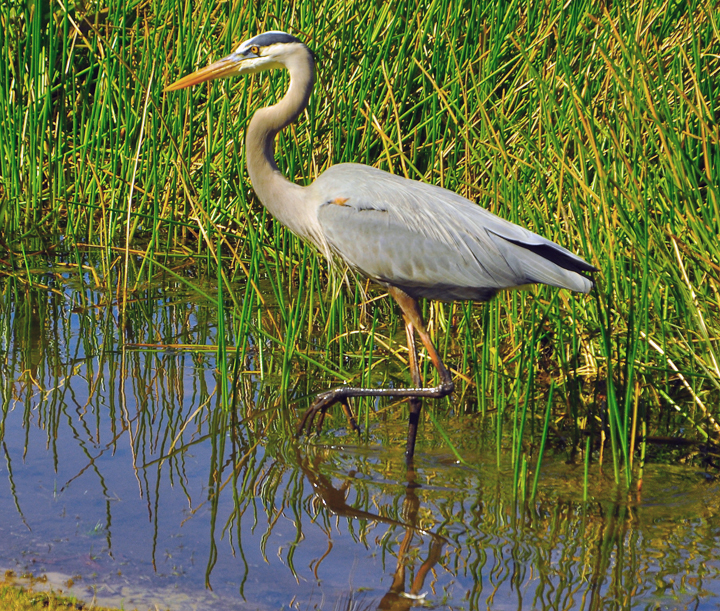
A four-foot great blue heron fishes the same back-nine pond every morning in Ponte Vedra, standing so still golfers mistake him for a statue bolted to the bank. Cliff explains why the bird is free pond management, why the mower swings wide around him instead of the other way, and what happens when somebody steps off the cart path for a closer picture.
The first time you see him, you will swear somebody bolted a lawn ornament to the edge of my pond. Four feet tall, blue-gray, one leg tucked up somewhere in his feathers, neck folded into a question mark, not moving a muscle. I have watched grown men in golf carts stop on the path, point, and whisper, "Is that thing real?" Then the neck uncoils faster than your backswing and there is a fish flapping on the end of that spear he calls a beak. Oh, he is real. He is the most patient fisherman on this entire property, and he does not have to buy a license or pay a green fee.
He works the same pond most mornings, the big one on the back nine, and he works it like a man with a route. Start at the shallow corner where the sun hits first and the little fish bunch up. Stand there until standing there stops paying. Then lift those long legs one slow step at a time, setting each foot down like he is testing ice, and set up twenty yards farther along. By the time the first tee time reaches him, he has eaten better than anybody at the clubhouse breakfast table.
People ask me if he is good for the course or bad for it, like everything wild out here has to be one or the other. Mostly, he is good, and I will tell you why. A pond on a golf course is a soup pot that never turns off. Sun, warm water, and fertilizer drifting in off the fairways will grow you more little fish, frogs, and tadpoles than any water should hold. Left alone, that pot gets out of balance, the water goes cloudy and strange, and I get phone calls. The heron is free pond management. He thins the crowd at the shallow end every single morning, eats frogs the size of softballs, and never sends me an invoice. The egrets follow my mower for the leftovers. The heron does his own hunting, standing still in water he helped keep honest.
He has rules, and after a few years you learn them or you look foolish. Rule one: he does not move for a mower. Gators slide off the bank when I roll up. Egrets flap ten feet and settle back down. This bird looks at a triplex coming down the pond bank, looks at me driving it, and decides we are both beneath his notice. So I mow around him. I swing wide, leave a shaggy crescent of grass at his corner, and come back for it after he has moved on to his next spot. Somewhere out there is a golfer who thinks that rough patch is a design choice. It is a heron choice. I just work here.
Rule two: do not walk up on him to get a picture. You can admire him from the cart path all day and he will pose like he is getting paid for it. Step off the path and close the distance and you find out that statue has a six-foot wingspan hiding in it. He comes off the water like a gray umbrella opening in a hurry, lets out a squawk like a rusty gate, and sails across the pond trailing those long legs behind him. He has emptied more than one golf cart of laughing golfers who were not expecting a dinosaur to take off in front of them. Because that is what he is, if you look close. That beak, those yellow eyes, that slow reptile patience — the dinosaurs never fully left Florida. Some of them just learned to fish my ponds.
In November he gets the pond mostly to himself, and I like working around him this time of year. The mornings come up cool, mist sits on the water, and he is already in his corner before my crew finishes coffee, gray on gray, only moving when a fish makes a mistake. The snowbirds will stop their carts and take his picture all winter, and he will ignore every one of them. He was here before the first tee time. He will be standing in those shallows long after the last cart is washed tonight.
Every course keeps a list of regulars. Ours has the dawn foursome, the league boys, the single who plays nine at lunch — and one tall, blue-gray fisherman who pays nothing, tips nothing, never fixes a ball mark, and still gets his corner of the pond mowed last, wide, and careful, every morning I am out there. Fair trade. He keeps my pond honest. I keep out of his way.