 The Fairway Wire
Editorial
The Black Crust on My Green Is Alive, and It Moves In When the Sun Gives Up
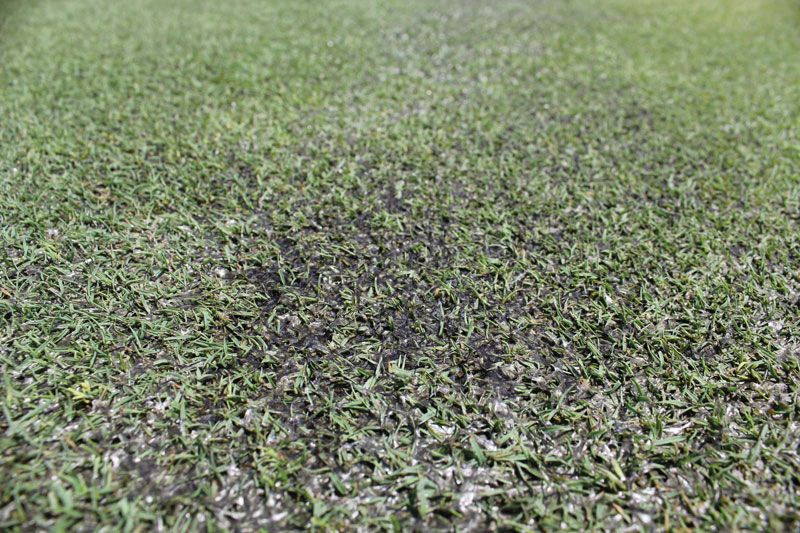
Every November a black, slick crust creeps onto the shaded corner of one of Cliff's greens — living algae that seals the surface, steals the light, and files its progress report in public. His fight is housekeeping, not just spray: air, sun, water discipline, and reading what the patch is honestly telling him.
Every November, on the same corner of the same green, a black patch shows up like a relative who knows exactly which week you are busiest. It is not dirt. It is not a dead spot, not yet. Scrape it with your fingernail and it smears, dark green-black and slick as pond scum, because that is close to what it is. Algae. On a putting green. Living right on top of the grass I get paid to keep perfect, in a crust thin as paint and twice as stubborn.
Folks hear algae and think of a pond that needs cleaning. I think of a green that has been wet too long and shaded too deep. That is the whole recipe, and November in northeast Florida cooks it perfectly. The days shrink. The sun rides low and the big oaks and pines throw shadows that used to clear the green by eight in the morning and now squat on it until ten. Dew that burned off by the first tee time in July just sits there in November, hour after hour, keeping the surface damp. Damp and dark and cool — you have built a little swamp the size of a kitchen table, and the swamp brings its own residents.
Here is the part golfers never believe: that crust is not just ugly, it is working against the grass underneath it in three directions at once. It seals the surface, so water that should soak in now sheets off or puddles, which makes everything wetter, which makes more crust. It shades the little grass plants trying to grow under it, stealing light they were already short on. And it competes — algae is alive and hungry and it got there first. Left alone through a wet winter, it does not stay a smear. The grass under it thins, then quits, and by spring you are not treating a crust anymore. You are sodding a scar.
So November me fights it the unglamorous way, and most of the fight is not chemicals, it is housekeeping. Air first: a venting pass with little solid tines, punching pinholes that let the surface breathe and dry without tearing the green up in overseed season. Sun second, and sun is a negotiation with trees that were here before the golf course was. I cannot take a chainsaw to every shadow, and honestly I would not want to — those oaks are half the beauty of the place. But a limb lifted here, a canopy thinned there, buys a green an extra hour of morning light, and an hour is a fortune this time of year.
Water discipline is third, and it is the hardest, because it feels wrong. A green with a black crust looks thirsty to a golfer. It is the opposite. I water that corner less, not more — short drinks, early, so what little sun we get can finish the drying — and I keep the mowers honest about it, because running a heavy mower over a slick crust smears it wider, like buttering toast with the problem. Some mornings the right call is to let the dew whip and a little patience do the work before a tire ever touches it.
There is a spray for it, yes, and I use it when the housekeeping is not enough. But thirty seasons of mornings teaches a man this: the spray knocks the crust back, and the conditions invite it right back to the same corner, like it kept a key. Fix the shade, fix the air, fix the water, and the spray becomes the backup singer instead of the whole band.
The funny thing is, golfers read that black corner all wrong. They see neglect. A greens keeper sees a progress report. That crust is the green telling me, in writing, exactly where my shade problem lives, exactly where my drainage slows down, exactly which sprinkler head has been a little too generous all fall. It is rude about it — it could just send a memo — but it is honest. Every course in Florida has a corner like mine. The only difference between the places that beat it and the places that sod it every spring is whether somebody got down on one knee in November, scraped it with a fingernail, and believed what it was saying.
So if you putt through a dark patch on my place this winter and it costs you a stroke, I owe you an apology and an explanation in that order. It is not that we quit on that corner. It is that we are in a slow argument with the sun, the shade, and a smear of green-black life older than grass itself — and I intend to win it by February, one dry morning at a time.