 The Fairway Wire
Editorial
The Biggest Woodpecker in Florida Treats My Dead Pines Like a Drum Kit and a Lunch Counter
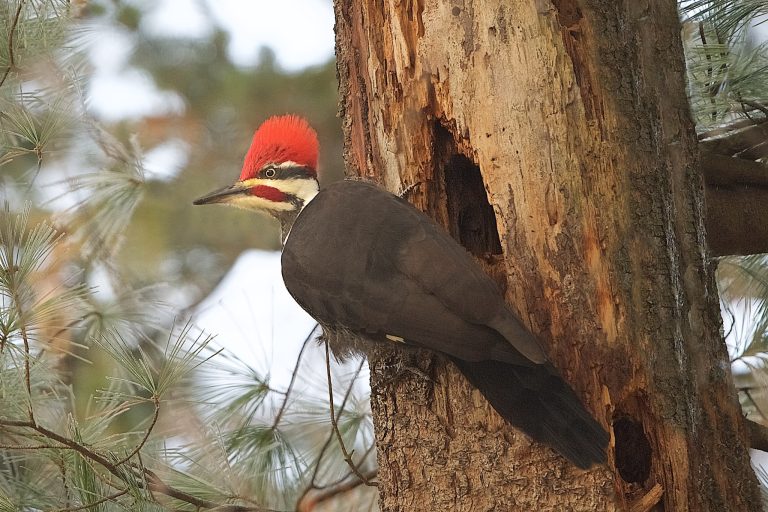
The pileated woodpecker is nearly the size of a crow, wears a red crest like a warning light, and announces itself across my Ponte Vedra course with a wild laugh and a drum roll on dead pine. I decide which dead trees stand and which ones come down — and this loud tenant is the best argument I have for leaving a few standing.
You hear him long before you ever see him. First comes a drumming so loud it carries across three fairways, like a man knocking on a hollow door with the back of an axe handle. Then comes the call, a wild rolling laugh that sounds like the jungle moved into my tree line in Ponte Vedra. Golfers stop their carts and look up. I just smile. That is the pileated woodpecker, and he is on the clock earlier than I am.
He is hard to miss once you spot him. Nearly the size of a crow, black as a tire, with white stripes down his face and a flaming red crest swept back like he is doing sixty into the wind. More than one golfer has told me he looks like a cartoon, and they are not wrong — the cartoon was drawn from him, not the other way around. But there is nothing cartoonish about his work. That big chisel of a bill is a demolition tool, and my dead pines are his job site.
Here is what he is after. A pine that dies standing does not stay empty. Carpenter ants move into the soft heartwood. Beetle grubs tunnel under the bark. To you it is a dead tree. To a pileated it is a lunch counter with the food sealed inside, and he opens it the direct way — by tearing off slabs of bark and chiseling holes so big and so square-cornered they look cut with a saw. I have picked up chips at the base of a worked-over pine as long as my thumb. No other bird on this property moves wood like that. He is not pecking. He is excavating.
Which puts him squarely in my department, because dead trees are a decision I have to make over and over. A dead pine standing over a fairway, a tee, or a cart path is a liability with limbs — sooner or later it drops something heavy, so it comes down, and it should. But a dead pine back on the rough line, away from play, is a different piece of property entirely. Left standing, it is housing and groceries for half the woods. The pileated cuts the first holes. Later tenants move into the ones he leaves — smaller birds, bats, all manner of quiet renters who could never cut a doorway of their own. One snag, years of use.
So we keep a few on purpose. Not many, and never where a falling limb can find a golfer. But back in the tree line there are pines that died two, three seasons ago and still stand on my say-so, silver-gray and full of square holes. Anybody who raises an eyebrow gets the same answer: that tree is occupied, and the tenant does pest control I would otherwise pay for. Every carpenter ant colony a pileated empties out of a dead pine is a colony that never goes looking for the wooden bridge, the pump house trim, or the cart barn posts. He eats my problems before they become my problems.
His one bad habit is paperwork — he leaves the evidence everywhere. A golfer will roll up on a fresh pile of chips and a trunk that looks vandalized and ask me if lightning did it, or kids, or some disease going through the pines. No, sir. That is a lunch receipt. Fresh chips, pale wood, holes with corners: the big woodpecker ate here this morning, and the tree was already dead when he ordered. He has never once touched a living pine on this course. He does not have to. The dead ones are stocked better.
A pair of them holds a big territory, and ours works the same stretch of tree line season after season, drumming on the hollowest snag they can find because it carries farthest — a bird that size does not whisper his announcements. Some mornings the drumming is the first sound on the course, ahead of my mower, ahead of the range picker, ahead of the first tee time's chatter. The crew has stopped treating it as noise. It is more like a time clock punching in.
Next time that wild laugh rolls out of the pines, do not just look for the bird — look at the tree he is on. Gray, dead, and more alive with tenants than half the green pines around it. That tree is not an eyesore. It is a drum kit, a lunch counter, and an apartment building, run by the biggest woodpecker in Florida, and he pays his rent in ants.