 The Fairway Wire
Editorial
The Baskets on My Greens Mower Tell Me How Fast This Course Is Growing
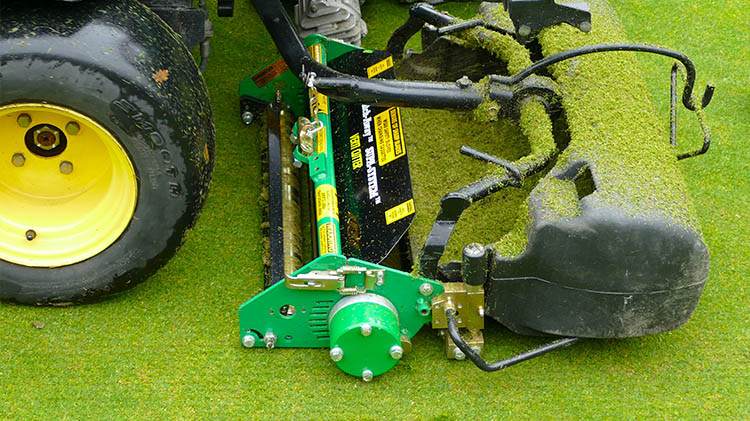
Every greens mower here carries baskets, and by the end of a morning those baskets are a report card on how fast this course is growing. In November, with young rye riding on top of slowing bermuda, a heavy basket or a thin one tells me whether today is a mow day, a roll day, or a leave-it-alone day.
Every greens mower on this property carries baskets, and most golfers figure they are just there to keep clippings off the putting surface. They do that, sure. But by the end of a morning, those baskets are also a report card. How much grass came off each green tells me more about what this course is doing than half the gadgets in my shop. I have a moisture meter and I trust it. I trust a full basket different, the way you trust a scale you have stood on for twenty years.
The habit is simple. My operator mows a green, lifts the baskets, and dumps them, and after a while your hands learn the numbers without a chart. A normal November green gives up a modest load — the basket maybe a third full, light, fluffy with ryegrass tips. A green that is pushing growth gives up twice that, packed and damp, and the operator stops mid-green to empty before the box spills its load back onto the surface he just cleaned. Nobody taught us this in a classroom. You learn it the way you learn rain is coming by the smell — by doing it ten thousand times.
November is when the baskets talk loudest, because right now my greens are really two grasses wearing one coat. Underneath, the bermuda has slowed to a crawl in the cool nights and is thinking about going dormant and tan. On top, the winter rye we seeded last month is young, eager, and growing like it has somewhere to be. Fresh rye after a mild week and a drink of fertilizer will fill a basket so fast you would swear somebody raised the mower. Then a cold snap rolls in off the ocean, the nights drop into the forties, and the same green gives up half as much three days later. The grass did not read a calendar. It read the thermometer, and the basket is where it filed the report.
That report runs real decisions. If the baskets come back heavy day after day, the greens are growing faster than the ball is rolling, and I have choices: mow twice, roll instead of cutting on the in-between days, or hold the next light feeding because the grass is clearly not hungry. If the baskets come back thin and dusty, something else is talking — the last feeding has worn off, a green is drying out, or the rye never came in thick in that spot. A thin basket on one green is a question. Thin baskets on all eighteen is an answer: the whole property is slowing down, and it is time to change the plan, not just the mower settings.
Every course has the green that lies and the green that confesses. Our shadiest green, tucked under the big oaks where the dew sits until nearly ten, always dumps a heavy basket, because wet rye weighs more and packs tight. I discount that one like a fish story. The green I believe is the plain one in the middle of the property, full sun, no excuses. Whatever its basket says on a Tuesday is the truest growth number I own. Superintendents with big budgets pay for clipping studies and laboratory charts. I have that green, a good operator, and two hands that know what a third of a basket feels like.
There is a catch, and an honest man admits it: the basket only tells the truth if the mower cuts at the same height, on the same schedule, with a sharp reel. Change any of those and you are measuring the machine, not the grass. That is why the reading happens with the same mower and the same operator when I can manage it, and why a sudden jump after we sharpen the reels fools nobody on my crew. We know the difference between grass that grew and grass that was finally cut clean. The number is homegrown, but it is not sloppy. It is a habit, repeated the same way, until the habit turns into information.
Golfers will never see any of this, and that is fine. What they see is a green that rolls the same on Friday as it did on Tuesday, and they figure that is just what greens do. It is not. It is a fellow at seven in the morning, tilting a basket into the light, deciding whether today is a mow day, a roll day, or a leave-it-alone day. The fanciest instrument on this course was already bolted to the mower. You just have to empty it ten thousand times before it starts talking.