 The Fairway Wire
Editorial
If the Flag Is Standing Straight Out, My Spray Rig Stays Parked
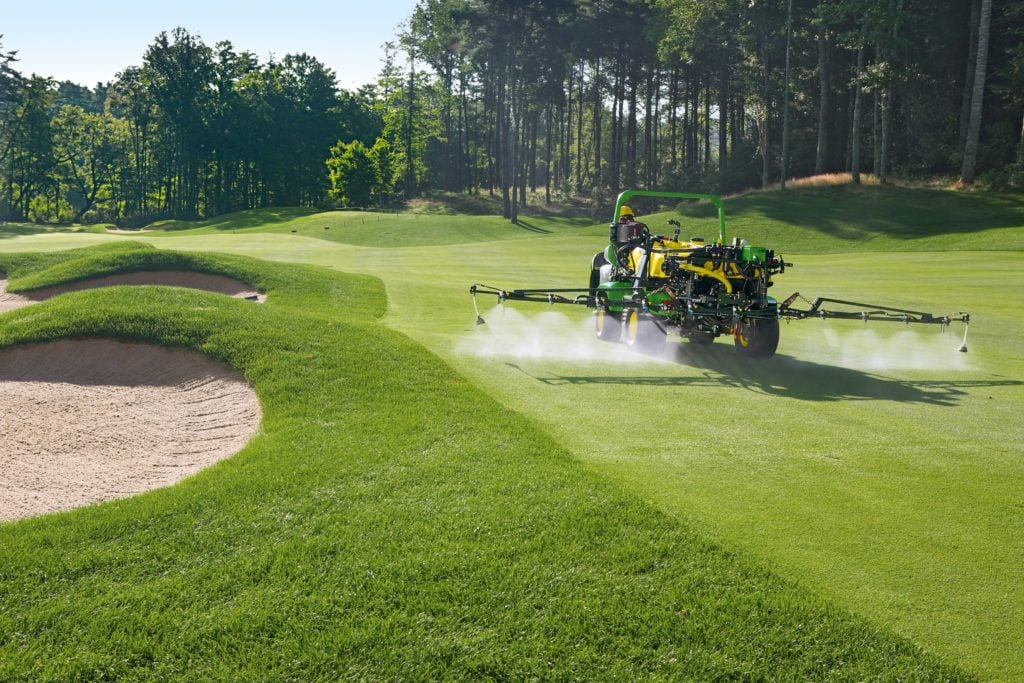
Spray day on my course is a weather decision before it is a work order. I explain how I read the flags, the pond, and the still morning air before a single gallon leaves the tank — because product that drifts helps nobody and costs everybody.
There is a whole morning's work on this golf course that can be cancelled by a flag. Not a red flag in a meeting, not a flag on a green — the little triangle of cloth on top of the flagstick, standing straight out and snapping in the wind like it is trying to get somebody's attention. When I see that on spray day, I park the rig, pour another coffee, and start replanning the week. Folks think spraying is the job. Deciding whether to spray is the job.
Here is what is riding on that decision. The tank might hold fertilizer, or a fungicide keeping a disease from eating a green from the edges in, or something to keep the weeds honest. Every bit of it is expensive, bought to land on a specific patch of grass, and it only works if it lands there. Product that lifts off the fairway and rides the wind into the pond, or across the fence toward the houses, did three things at once: it wasted money, it missed the grass that needed it, and it put chemistry somewhere I never intended it to be. A sprayer does not know where the target is. That part is on me.
So spray morning starts with weather, and not the weather on the television. The flags tell me the truth hole by hole, because this course does not have one wind — it has a dozen. The holes along the water run different from the ones tucked in the trees, and a breeze that feels gentle at the shop can be doing real work out on the open holes. I drive the exposed ground first and watch the flags and the pond. A pond is an honest wind gauge. Glass means one thing, a steady ripple means another, and little whitecaps on a golf course pond mean the rig stays parked, full stop.
The trickiest mornings are the still ones, and this surprises people. Dead calm at daylight feels like a gift, and sometimes it is a trap. On certain cool, clear mornings the air near the ground is heavier than the air above it, and fine spray droplets can hang in that low layer and wander off sideways like they have got somewhere better to be. Old hands call it an inversion, and you can spot its cousins without any instruments: fog sitting in the low spots, dew that is not burning off, smoke from a chimney going sideways instead of up. When the morning feels too quiet, I wait. An hour of sun usually stirs the air up, and a spray that goes on at eight instead of six lands where I aimed it.
When the window is right, the work itself is a study in boring done carefully. Bigger droplets instead of a fine mist, because heavy drops fall and fine ones travel. The boom kept low. Speed steady. Foam markers or the GPS leaving a record of every pass, because overlapping a strip doubles the dose on that grass and skipping one leaves a stripe that will announce itself in a week, green as a billboard. I have made that stripe. Once. The whole crew still knows which fairway it was.
There is a clock on all of it, too. A lot of what I spray needs the grass to stay dry for some hours afterward, or works best before the heat starts cooking. That is why you see us out there at hours when sensible people are asleep, booms folded out in the headlights. We are threading a needle between the wind coming up, the golfers coming out, and the sun getting high, and some days the needle wins.
Golfers ask me sometimes why the thing they are worried about did not get sprayed on the day they expected. The answer is usually standing on top of a flagstick, snapping in a wind they are cussing for entirely different reasons. They hate that wind because it moves their ball. I respect it because it moves everything I put in the air, too — and I am the one who answers for where it lands.
So if you are ever out early and you see my rig parked with a full tank and me standing next to it doing apparent nothing, I am not broken down and I am not being lazy. I am watching a flag make a decision that costs real money either way. When it finally goes a little slack, you will hear the engine. Until then, the most professional thing on this whole golf course is a sprayer that is not spraying.