 The Fairway Wire
Editorial
I Drag a Hose Onto a Perfect Green So It Can Take a Sip, Not a Bath
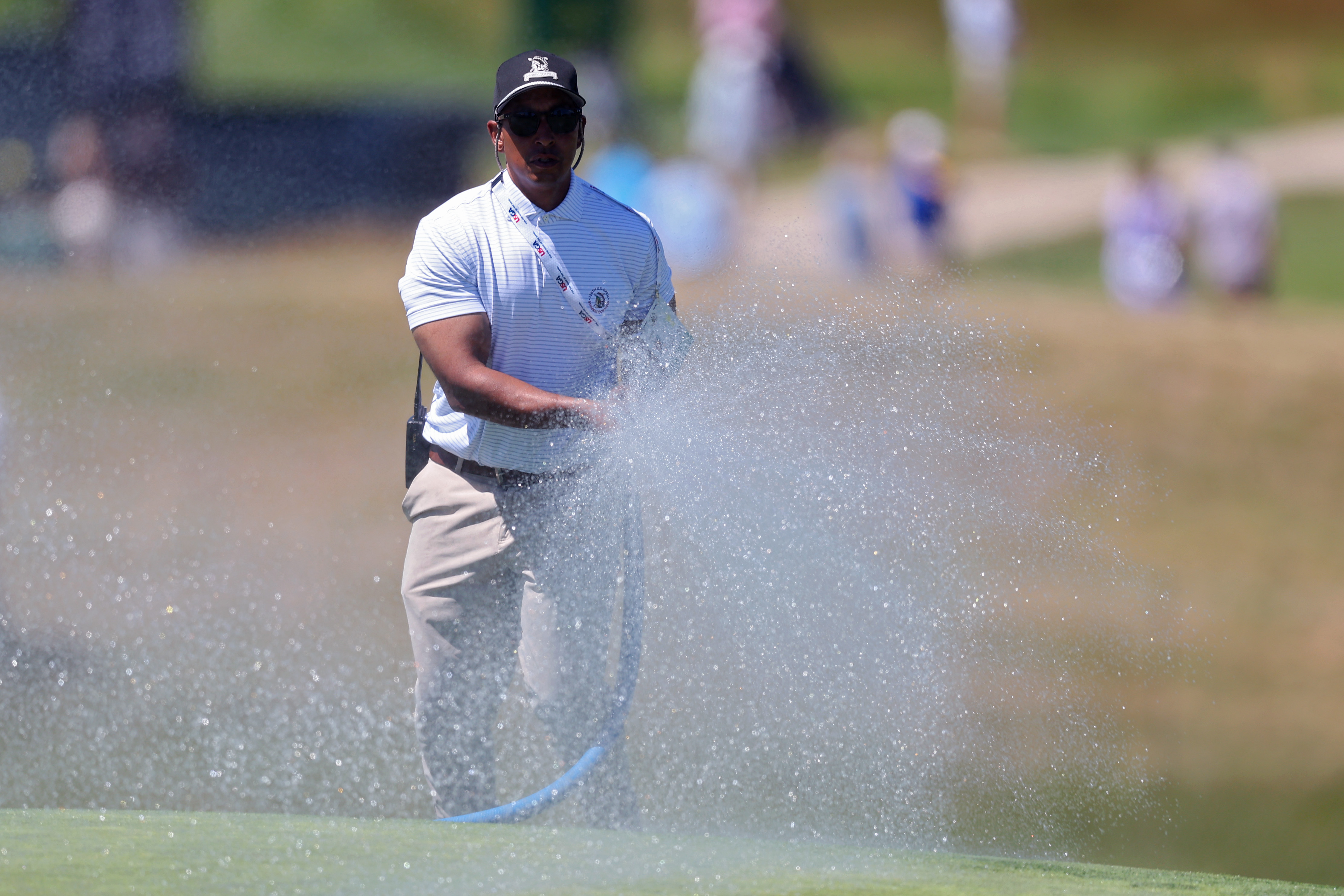
A greens keeper dragging a hose across a perfect-looking green at two in the afternoon is not watering it — he is cooling it. Cliff explains syringing: the light mist that wipes a green's forehead, the footprints that give stressed turf away, and why no sprinkler system can read a green the way a pair of boots can.
If you ever see me standing in the middle of a green at two in the afternoon, dragging a heavy hose behind me and waving water over grass that already looks perfect, I have not lost my mind. I am giving that green a sip. Not a drink. A sip. There is a difference, and on a Florida afternoon the difference is the whole job.
The word for it is syringing, and it confuses people because it looks like watering and it is almost the opposite of watering. Watering is for the roots. You run the sprinklers at night, deep and slow, and the moisture goes down where the plant actually drinks. Syringing is for the leaf. You mist the surface just enough to wet the blades and cool them off, and most of that water never reaches the soil at all. It evaporates, and as it evaporates it carries heat away with it, the same way sweat cools your skin. I am not feeding the grass. I am wiping its forehead.
A green will tell you when it needs it, but it whispers first. The color goes a little dull, a shade off from the healthy shine it had at breakfast. Then the blades start to curl the tiniest bit, folding themselves to hide from the sun. Walk across it and your footprints stay. That one gets my attention every time. Healthy turf springs back behind your shoe. Stressed turf holds the print like it is too tired to get up. We call that footprinting, and when I see my own boots looking back at me from a green, the hose comes out.
Here is the part nobody believes: the sprinklers cannot do this job. The irrigation system is built to cover the whole green evenly, and evenly is exactly wrong at two in the afternoon. One corner bakes because the wind hits it. One low spot sits happy and wet. The high side near the collar dries out first, every single time, because water runs downhill and sun does not care about fair. A sprinkler treats all of that the same. A man with a hose treats it like a map. I can spend three extra minutes on the thirsty corner, skip the happy low spot entirely, and put the water only where the grass is asking for it. No computer I have ever met knows my greens the way my boots do.
The hose itself deserves some respect. It is long, it is heavy, and it wants to kink, coil, and drag across the very surface I am trying to protect. You learn to carry loops of it over your shoulder, to feed it out behind you as you walk, and to never, ever let it snake across a line somebody is about to putt over. You learn the nozzle, too. I am not blasting anything. I keep the stream broken up into a soft fan, more weather than water, and I keep it moving. Stand in one spot too long and you have done the thing you came to prevent — you have soaked the surface, sealed it off, and cooked up the steamy conditions that disease just loves. The art is in leaving. Every green gets minutes, not a soaking.
People ask why the grass gets stressed at all if we water every night. Because a putting green is not a lawn. We mow it so short that the plant is living right on the edge of what it can stand, with roots to match — shallow, because the plant puts its energy where the cutting tells it to. A plant with short roots in sandy Florida soil, on a day when the heat index is pushing triple digits, can fall behind by early afternoon no matter how good last night went. It is an athlete playing on a full stomach from yesterday. By the fourth quarter, it still needs something cold on its neck.
So if your group gets to a green and there is a crew member out there with a hose, give him thirty seconds and a little grace. He is not holding up your round for fun, and he is definitely not watering for the fun of getting wet shoes. He is cooling a surface you are about to trust with your best putt of the day, one sip at a time, so it will still be alive and honest when the last group comes through at six.
That hose is heavy, and my shoulders know it by August. But a green that survives a hard afternoon is a green that putts true at sunset, and that trade is worth every loop.