 The Fairway Wire
Editorial
Before Anything Goes in My Sprayer Tank, Plain Water Goes on the Pavement First
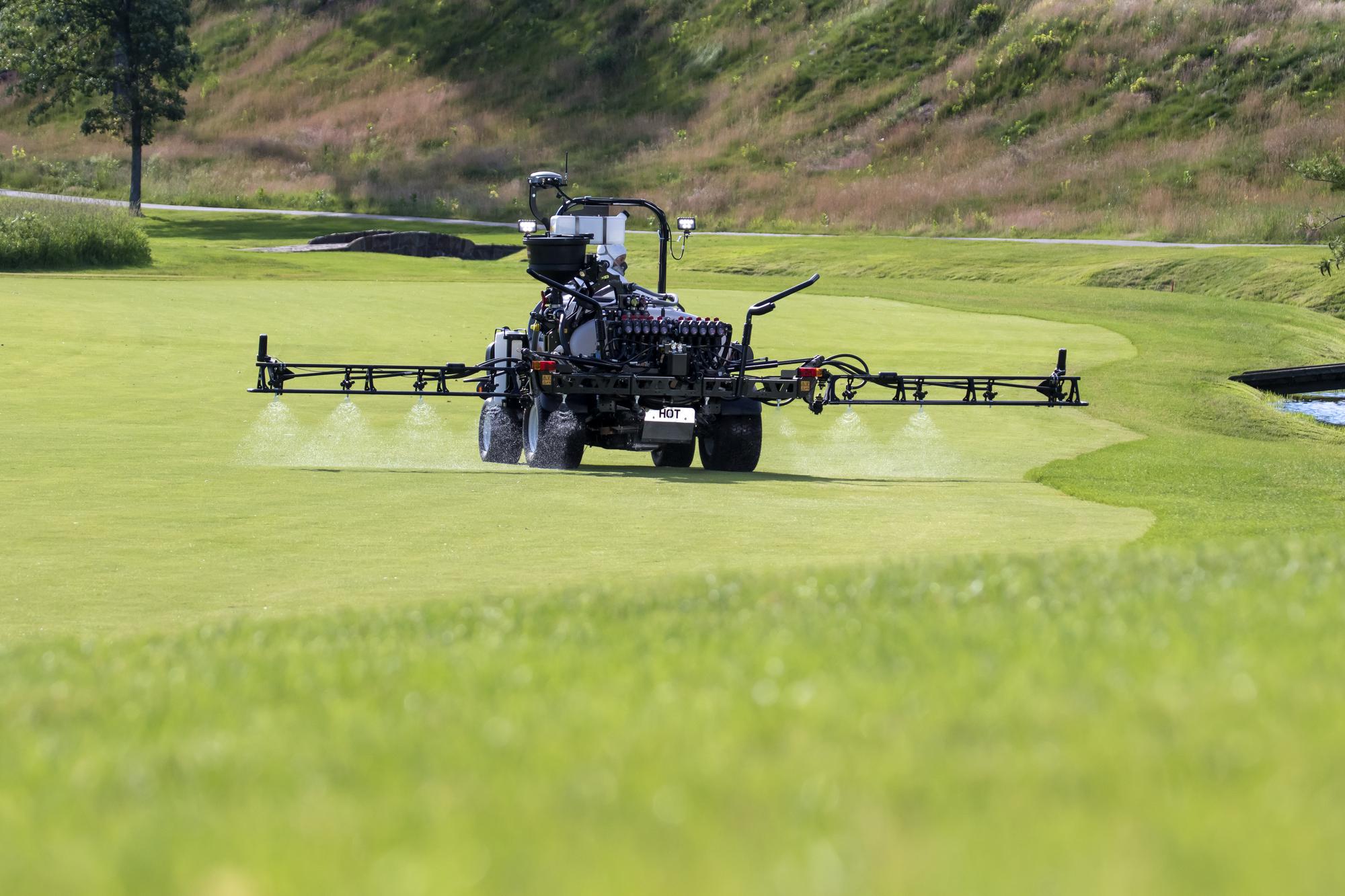
Before any product touches a fairway, Cliff runs his sprayer with plain water on the shop pad, catching worn nozzles in a row of jars and reading the wet pattern on concrete. It is the cheapest test on the course, and it protects the ponds, the grass, and a very pricey tank.
The most honest test on this golf course does not happen on a green. It happens on the concrete pad behind our shop, with plain water in the tank, before a single ounce of anything else goes in. I park the sprayer, drop the booms wide, run it standing still, then roll forward at working speed and watch what the pavement tells me. Concrete does not flatter you. It shows every secret that machine is keeping, in a wet pattern a blind man could read.
A sprayer looks simple from the cart path. Big tank, long arms, a man driving slow with a serious face. What you are really looking at is about twenty little nozzles that are supposed to act like one. Each has a tip, a screen, and a seal, and each is quietly trying to retire. A tip wears a hair wider every season and puts out more than its neighbor. A screen catches one flake of rust and puts out less. A seal starts to weep after the pass, dribbling a goodbye stripe nobody ordered. On grass, all of that hides for a week. Then it shows up as light and dark bands across a fairway, and by then the whole course can see what I should have caught on the pad.
So we catch it on the pad. I lay a row of plain jars under the boom and run each nozzle into its own jar for the same counted time. They should all finish in a dead tie. When number nine is an inch proud of the rest, number nine is not enthusiastic. It is worn out, and it gets replaced, because over a full tank that inch becomes gallons in the wrong places. When one jar comes up short, I do not argue with it. I pull the screen, rinse the grit out, and run it again until the row agrees with itself.
Then comes the rolling part. I drive the pad at the exact speed I plan to drive the fairway, because a sprayer does not know what the label on the jug says. It knows pressure, speed, and boom height, and if any one of those moves, the dose moves with it. Go faster and every acre gets a thinner coat. Slow down in a turn and the inside gets a double helping. Let a boom bounce low and that side paints a hot stripe while the other side mists the air. The wet fan on the concrete shows the overlaps and skips plain as handwriting. I would rather read that story in water, behind the shop, than read it in grass color in front of two hundred golfers on Saturday.
Wind gets a vote too, and here in Ponte Vedra the ocean always sends a representative. A mist that behaves at seven can start leaning sideways by nine, and product that drifts does not care that your intentions were good. It lands where the breeze puts it, and some of our fairways sit a polite distance from ponds full of bass, herons, and consequences. If the fan will not hold its shape on the pad, the tank stays parked and we go mow something instead. Waiting costs an hour. Guessing wrong costs a pond bank or a month of explaining a stripe.
There is a money side nobody puts on a brochure. What goes in that tank is some of the priciest liquid on the property, priced by the ounce and unforgiving of sloppy math. A machine running ten percent hot is not ten percent better. It is ten percent of a very large bill poured into the dirt, and the grass cannot even use the extra. Running ten percent lean is worse the other way. The weeds germinate right through it, and I get to buy the pass twice. The jars and the pavement are cheap. Everything after them is not.
I will admit there is a ritual to it I just plain like. Early light, coffee going cold on the fender, the pump humming, that first gray fan spreading even on both sides when the machine is right. The young hands think the test is about the sprayer. It is about patience. Anybody can fill a tank and go be productive. The work is proving the machine deserves what you are about to pour into it, while the only thing at stake is water on concrete.
Next time you see stripes of health across a fairway and wonder at the aim, picture that pad behind the shop. The prettiest pass I make all week is one nobody ever sees, and it is made of nothing but water.